Zach SternCommercial lawyer

Work Interleaf

Interleaf · Contract review

A contract workstation that keeps the question next to the words.

Answering a contract question usually means hunting through the agreement for every clause that touches it. Interleaf keeps the document, its connections and the open questions in one place, and checks the wording with fixed rules that give the same answer every time. The legal judgment stays with the reviewer.

Prototype · two drafting checks recorded September 19, 2026 · see the record

Interleaf's archived matter map: a contract's clauses drawn as connected nodes, with an inspector showing an open review question. Made-up content.
Archived prototype Made-up agreement

A clause is only part of the answer.

A sample agreement, four clauses, two of Interleaf's drafting checks. Each check is a small fixed rule that looks for one drafting pattern.

Made-up agreement · §§ 6 to 9Recorded run
  1. NoticesNotices shall be delivered by email to the notice address designated by each party.
  2. Security incidentParty A shall provide written notice of a security incident within 24 hours, in accordance with the Notices article.
  3. IndemnityParty A shall indemnify Party B against covered third-party claims, subject to a separate $300,000 limit.
  4. Limitation of liabilityAggregate liability shall not exceed $100,000. Indemnification is addressed in Section 8., excluding indemnification obligations. The separate indemnity limit in Section 8 applies to those obligations.
Findings from the two checks20
  1. § 7 · Security incident

    A notice duty with no delivery rule.

    "Party A shall provide written notice of a security incident within 24 hours." Fine, but notice to whom, and how? Section 7 doesn't say.

  2. § 6 · Notices

    The delivery rules live in another section.

    Section 6 says notices go by email to each party's designated address. Nothing connects the incident notice to it. The first check flags exactly that gap.

  3. §§ 8 and 9 · Indemnity and the cap

    A cap that doesn't say what it covers.

    The general cap is $100,000. The indemnity has its own $300,000 limit. Section 9 mentions indemnification without saying whether it sits inside the cap or outside it. The second check flags that.

  4. Two edits, and both checks come back clean.

    Section 7 now says notice goes "in accordance with the Notices article." Section 9 now carves indemnification out of the general cap and points to the separate limit. Same two checks: two findings before, none after.

  5. The judgment stays with the person.

    What starts the 24-hour clock? Which claims are covered? Do the limits reflect the deal the parties meant to make? A fixed rule can spot the pattern it was written for. It can't answer those, and it isn't supposed to.
    Switch between the two drafts yourself

The words, the connections and the questions in one place.

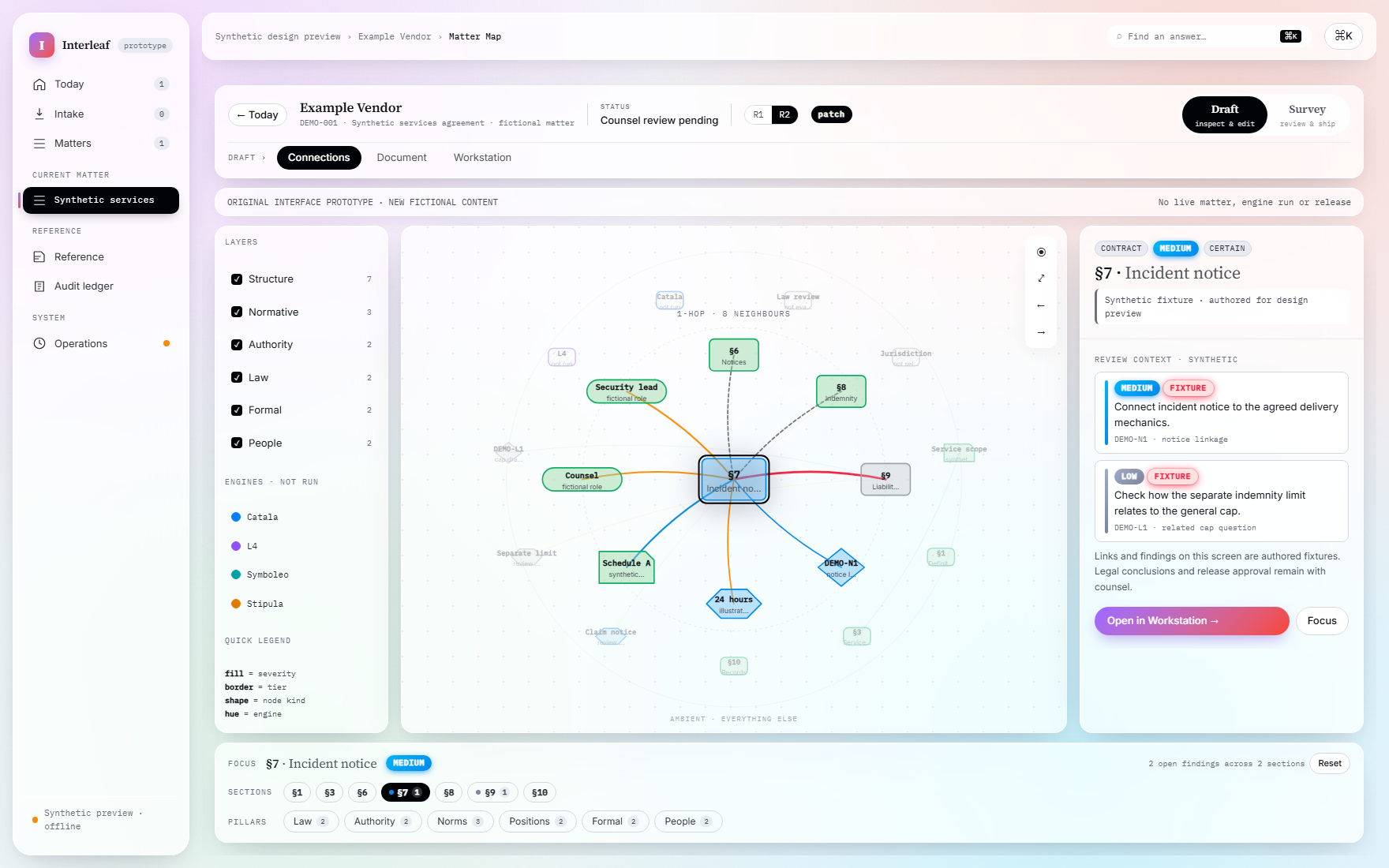
One matter means one contract with its related documents and open questions. The map shows how the clauses connect; the workstation keeps the wording beside the review questions.

Interleaf's archived matter workspace with a made-up graph, layers and inspector

Matter map: one contract with its related documents and open questions, drawn as connected clauses.

Archived prototype · made-up contentOpen full-resolution image

Keep the words in view

Every finding points back to the clause and the clause it relies on, so a reviewer reads the actual wording, not a summary.

Show the connection

A notice duty and its delivery rules can sit sections apart. The link between them is part of what a reviewer needs to see.

Keep the open part open

A question stays a question until a person decides it. Nothing in the workspace records a decision for you.

Recording · 37 seconds

Watch the prototype in use.

The archived prototype's own screens with a made-up agreement: select a clause, move to the incident notice, open the workstation and expand a review question.

Silent recording of the archived prototype. Nothing runs behind it. Open the recording directly.
Read the recording transcript
  1. The archived Interleaf prototype. Made-up content; nothing runs behind it.
  2. Select the limitation of liability clause. The map refocuses and its inspector updates.
  3. Recenter on incident notice. The review questions were written for the prototype.
  4. Open the Workstation tab. Made-up clauses sit beside a review rail.
  5. Scroll from the notice question to the indemnity and liability clauses.
  6. Expand the second review question. Both items stay open; no decision is made.

Open the original text track for the exact timed captions.

A grade should show what backs it.

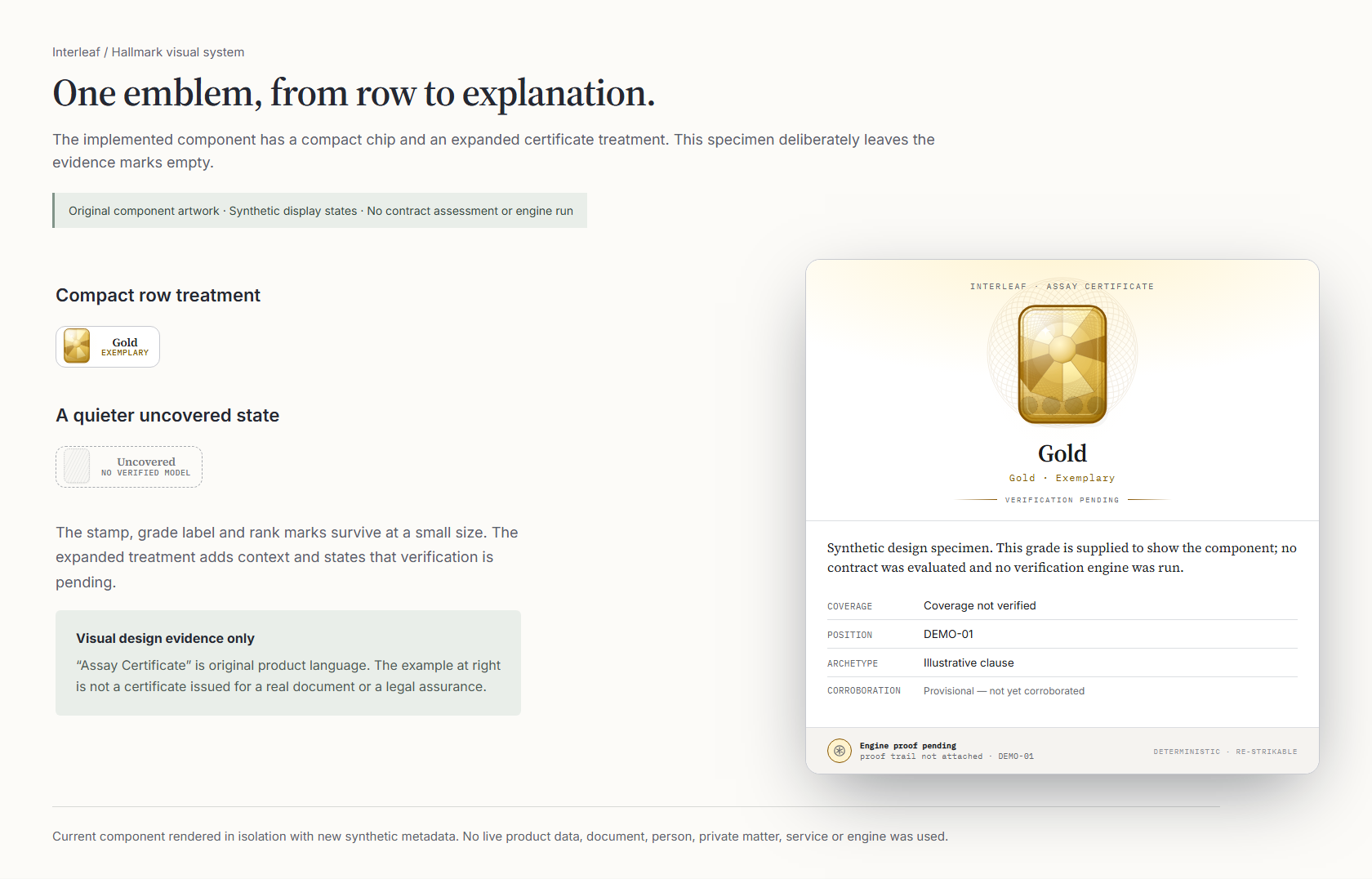
The Hallmark is Interleaf's mark for a grade and, separately, the kinds of evidence behind it. It's modeled on the stamp an assayer strikes into metal. The grade and the supporting marks are kept apart, so evidence never inflates a grade.

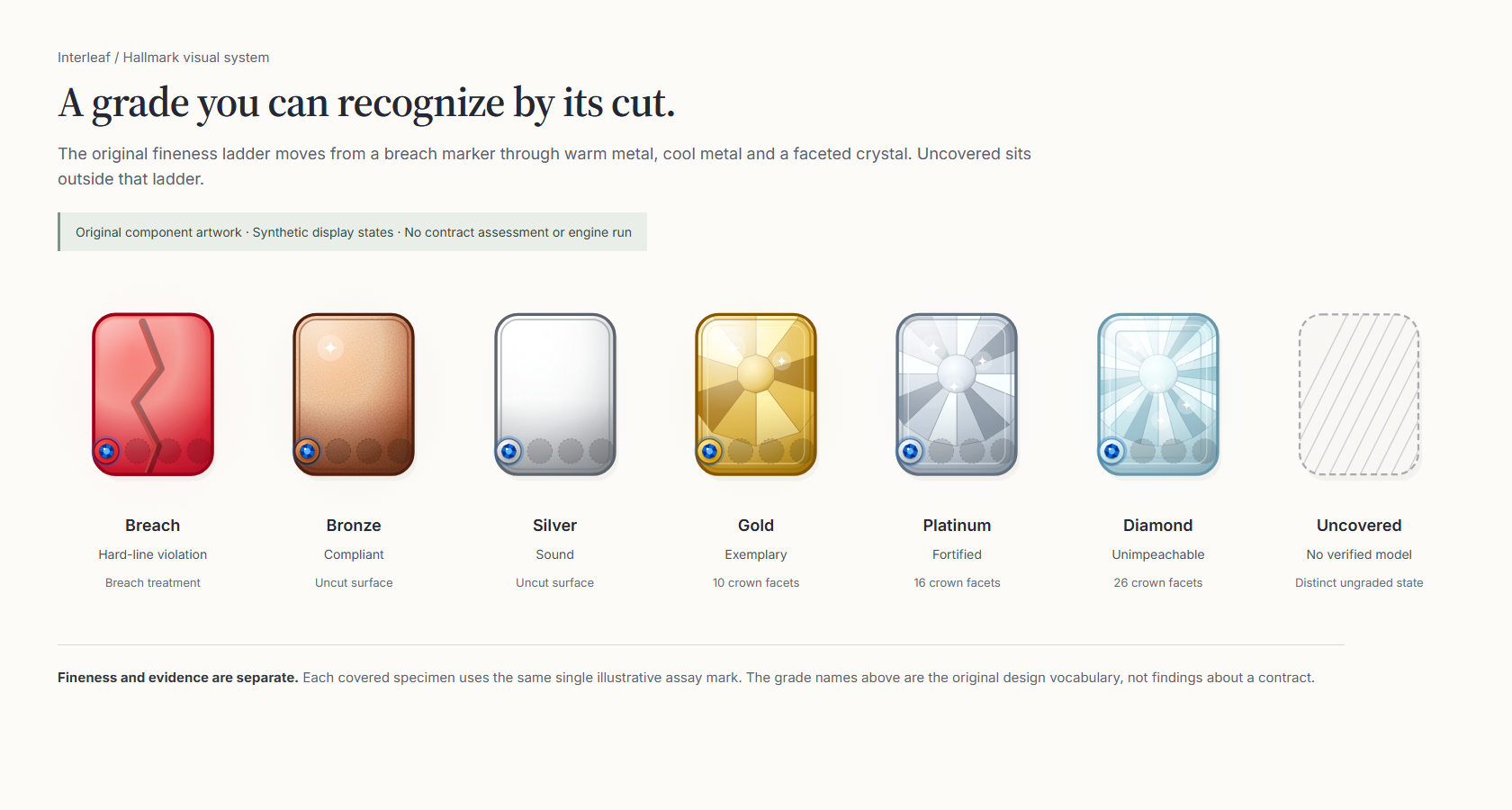
Hallmark grade board: specimens from the grade ladder and a separate Uncovered state.
Grade and coverage. "Uncovered" has its own shape, outside the grade ladder.
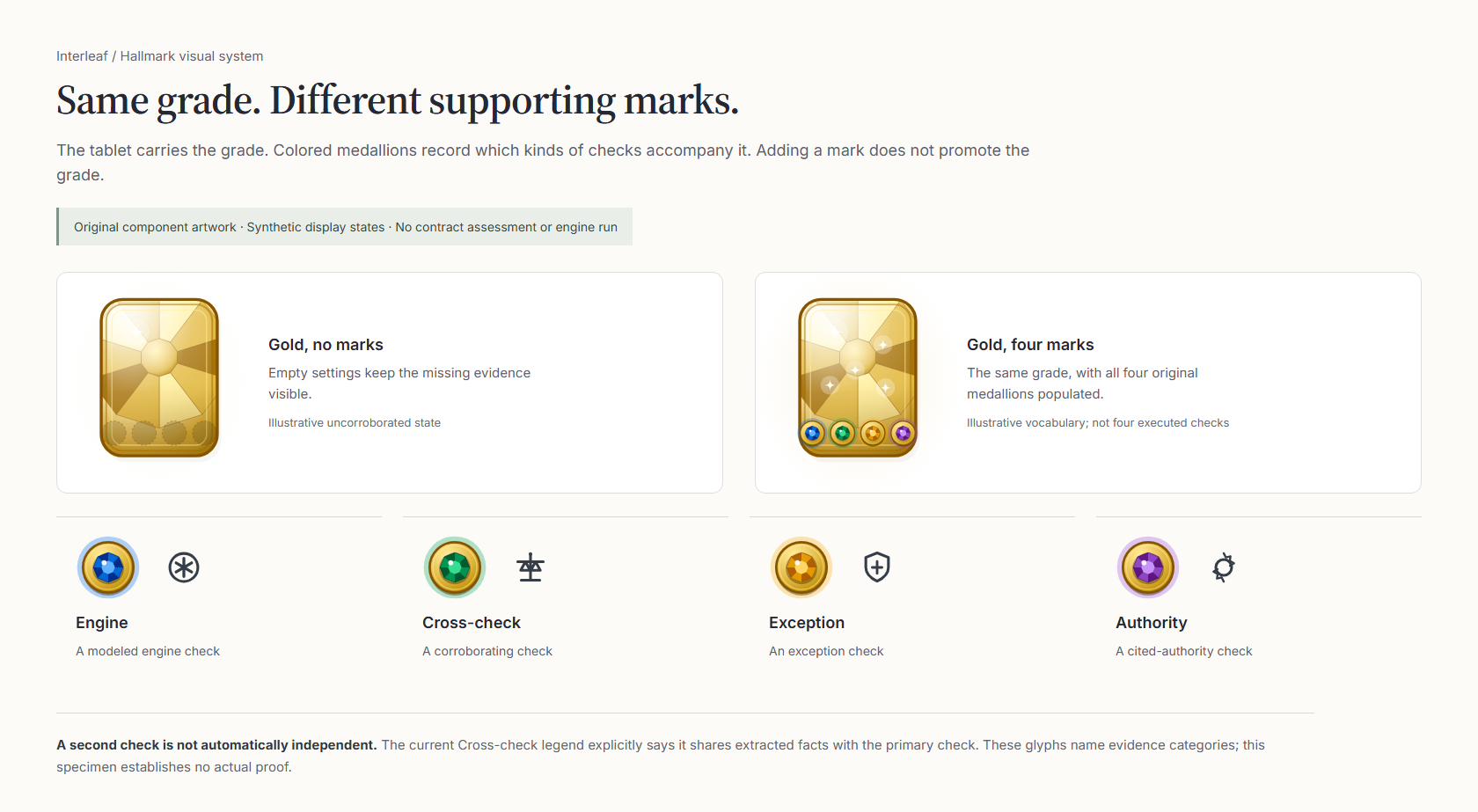
Hallmark evidence board: the same specimen shown with empty and filled evidence settings.
Supporting marks. Four kinds of evidence. Filling them doesn't raise the grade.
Hallmark chip and detail board: the expanded specimen names what is still pending.
What the detail discloses. The expanded view names what isn't verified yet.

Component study Current component artwork with made-up inputs. No assessment ran. Select a board to open it at full size.

Fixed rules at the center. Language models only at the edges.

At its core, Interleaf is designed to check an agreement's structured parts against a library of positions, using rules that give the same result every time. Language models help at the edges, such as sorting documents or putting findings into plain English. A model never decides what changes in a document, which redline to use, or whether a result goes out.

For some hand-picked clauses, the design adds three existing tools built by others, each for one narrow question: what duties a clause creates and whether one is breached (eFLINT), whether a hand-built model of a clause is sound (Catala), and whether an exception overrides an obligation (clingo). Recorded runs from May 2026 used each one in the private build on one clause family, limitation of liability.

The design started from research. AI agents worked through papers collected in a reference manager; one recorded sweep ran 46 searches and had to look for evidence against the idea as well as for it. The agents then checked how later papers received each source. When the citation service's quota ran out partway through, the papers it hadn't reached were marked unverified rather than assumed.

The build used Epistemic Skills. In one review, AI reviewers tried to break a claim and caught an earlier write-up overstating what Catala verifies. The correction is kept in the record.

What went into this work.

What I did

I decide what each project is for and check what comes back. I work with contracts, and Interleaf is the tool I wanted: the contract and its matter in one place, with connections you can follow and the legal decisions left to the reviewer. It's built around a rule I hold for AI on legal work: a model never decides what changes in a document.

What the AI did

AI tools write the code. They built the workspace, rendered the exhibits and ran the two recorded drafting checks. The Hallmark started from a design brief in a dedicated Claude Design session.

How I work with AI tools

What ran, and what it shows.

Recorded
On September 19, 2026, two existing checks ran on four clauses entered by hand as structured data: two findings before the edits, none after. The checks' three existing focused tests passed. No AI model was involved.
Prototype
The workspace views and recording are the archived prototype with made-up content. The Hallmark boards are a separate component study.
Name
Interleaf was called Steno during the build, so the prototype's own code and the JSON records here still use that name. The workspace views, the recording and the Hallmark boards were rendered again from the archived prototype with only the name changed; in the sidebar the longer name is set slightly smaller so the layout still fits.
Not shown yet
Interleaf reading a document file and building the clause connections itself, and the formal tools running on any clause in ordinary prose. Zero findings from two checks doesn't clear an agreement.
The full record: inputs, provenance and limits

The revised notice clause was recognized from its wording alone; this isn't evidence that a parser extracted or resolved the connections. eFLINT, Catala and clingo didn't run for this example. The recorded party labels were replaced with Party A and Party B for presentation; the rest of the clause wording and the findings are unchanged. The amounts, the 24-hour period and the edits are illustrative, not recommended terms.

Interleaf's source is private, so these records are what you can check. The Hallmark notes record that the cross-check shares extracted facts with the primary check, so independence isn't implied, and that grade words are design vocabulary, not legal conclusions.

The research record notes the correction on Catala: an earlier write-up described it as verifying a clause; a design review narrowed that to checking that hand-built models are structurally sound.

Next projectSaveBench
All work
Archived prototype · made-up contentOpen full-resolution image