Zach SternCommercial lawyer

Work Neuraxic

Neuraxic · Writing fiction

Writing a story and its world together.

I wanted a story's prose, people, places and rules to develop together, and a way to try another version without losing what I'd already decided. Neuraxic is the writing app I'm shaping for that. A new detail stays a proposal until the author accepts it, and a what-if version keeps the point it started from.

Interface study · the app's own screens with a made-up story world · five tests passed on September 19, 2026

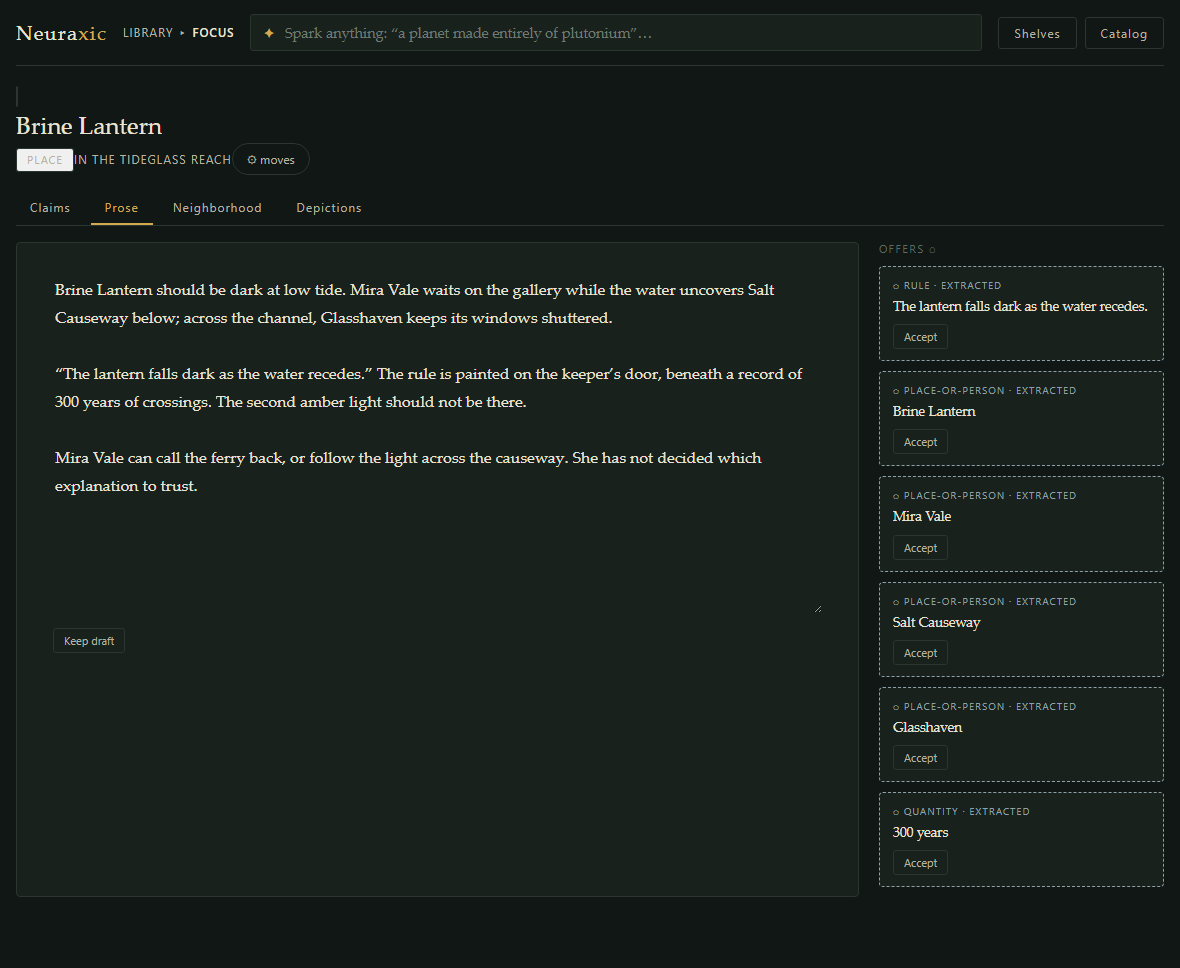
Neuraxic draft view: a short made-up passage about Brine Lantern, with the rules, names and quantities the app found listed in the margin as offers
Interface study · made-up story The draft view. The app lists the rules, names and quantities it found in the text as offers in the margin. None was accepted.Full size

A detail is a proposal until the author accepts it.

Neuraxic keeps a story's facts as claims, single statements such as "the lantern falls dark as the water recedes." Each claim is either a proposal or canon, the version of the story the author has settled on.

Write the draft

The app finds rules, names and quantities in the text and offers each one in the margin. Its own code does this the same way every time, with no AI model.

Seal what's settled

Sealing a proposal makes it canon. On screen, an open seal marks a proposal and a gold seal marks canon.

See the connections

The same subject opens as a draft, a list of claims or a map of its relationships.

Try a what-if

An alternate version starts from a fixed point in the main story, so later changes there don't leak into it.

A detail appearing on screen doesn't make that decision for the author. The Claims screen states the rule in the app's own words: "A proposal becomes canon only when you seal it. Every seal writes a receipt." The Seal button runs the same step the tests further down call promotion.

One subject, four ways to see it.

These are four of the app's real screens, filled with a made-up setting called The Tideglass Reach. Only the data is invented.

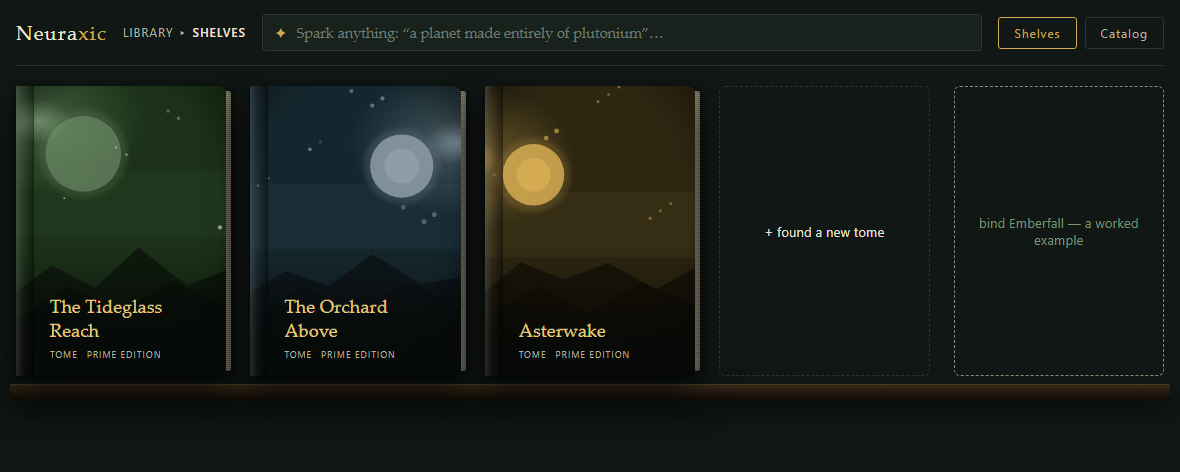
Neuraxic library with three fictional worlds presented as procedural book covers

The Library shows each story world as a book on a shelf. The covers are placeholders the app draws with code; no image model made them.

Interface study · made-up storyOpen image in a new tab

A workspace that starts from ideas

A tome groups one story world, and a loose leaf is an idea not yet placed in one. The Library holds the tomes, and the Catalog also lists the loose leaves. Open any element and it becomes the focus, with its draft, claims and relationship map as views of the same subject.

A lamplit archive

Dark green surfaces, parchment-toned text and warm gold make the app feel like a place to read and think. The marks carry meaning: open and gold seals separate proposals from canon, and ember-colored findings draw attention to concerns.

Follow one idea through the app.

The same made-up world, from the shelf down to a single subject and back. The recording is silent; its captions and the transcript describe each step.

Interface study · made-up story A 34-second silent recording of real navigation in the app: from the library into one world, through its claims, draft, neighborhood and history, and back to the claims. Nothing is saved along the way. The labels are small, so full screen helps.Open the recording directly
Read the descriptive transcript
  1. 00:00 · Choose a world. Each tome is a place to keep related ideas, prose and claims.
  2. 00:04 · Open a tome, then focus on one of its elements.
  3. 00:07 · The claims view keeps canon and an unsealed proposal visibly distinct.
  4. 00:12 · Read the draft beside the offers the app found in it.
  5. 00:18 · See the named relationships around the same subject. The map is another way to read the world.
  6. 00:24 · Switch to the history lens, where claims carry time marks. Gold marks canon, and a dashed outline marks the proposal.
  7. 00:28 · Return to the claims. The proposal is still unsealed.

What belongs in this version of the story?

Neuraxic calls each version of a story's facts a continuity. The five tests answer two questions: what can a version of the story see, and what has the author accepted? The diagrams explain the tests with a second made-up setting, Bellweather Reach. They aren't screens from the app.

A proposed detail shows up before anyone accepts it.

The main story holds one claim: the beacon is lit. Ask what this version knows and that claim comes back, even though it is still a proposal.

Coming back in the answer is what "visible" means. Visible and canon are separate questions.

Main story

The beacon is lit.

Proposal Recorded before the split

Ask what had been recorded as of an earlier moment, and anything recorded later stays out.

A what-if version starts from a fixed point.

The author starts an alternate version. Neuraxic records the point in the main story where it splits off.

The what-if can see the main story's claims up to that point. Nothing is copied or accepted along the way.

Main story at the split

The beacon is lit.

↓ The what-if sees the main story up to the split

What-if version

The beacon is lit.

Visible from the main story

The what-if keeps its starting point.

Later, the main story adds a claim: the causeway is closed. Ask both versions what they know at that later moment.

The main story includes the new claim. The what-if still sees the beacon, but not the causeway claim added after the split. The main story's edit is neither rejected nor erased.

Main story, asked later

The beacon is lit.

The causeway is closed.

New main-story claim

What-if, asked later

The beacon is lit.

The causeway claim came after the split.

A conflict stays a proposal until the author decides.

Another test starts with a canon claim, then records a claim that gives a different value for the same detail of the same thing in the same version.

Here, "the beacon is unlit" conflicts with the canon claim that it is lit. Neuraxic reports the conflict and keeps the new claim as a proposal. The idea stays available, and canon stays unchanged until the author decides.

Canon

The beacon is lit.

Recorded first

Proposal

The beacon is unlit.

Conflict reported · stays a proposal

Accepting a proposal leaves a receipt.

When the author promotes a proposal to canon, Neuraxic writes a receipt that records who did it. Send the same promotion again with the same identifying key and it returns the original receipt.

One test saves the first promotion, then opens a fresh session before retrying. The receipt still matches.

Chosen proposal

A claim the author decides to accept

↓ The author promotes it

Canon receipt

Who promoted it
Recorded
Sent again
Same receipt

Where I want to take it.

The wider design separates what's true in the story world, what the story shows, and what characters or readers believe. A character can be wrong while the author knows the answer.

Time
When an event happens in the fiction is kept apart from when the author records it.
Versions
An alternate version starts from a chosen point in the main story.
Contradictions
A broken rule might become a mystery, an exception or a revision, and the author decides which. A shared story structure could later support adaptations without silently changing the underlying world.

What went into this work.

What I did

I decide what each project is for and check what comes back. Here, I wanted a story's prose, people, places and rules to develop together without losing track of what I'd already decided. After the first prototype, I asked for the story to be shown as a map of connected parts while the app stays a good place to write.

What the AI did

AI tools write the code. That includes the five tests on this page.

How I work with AI tools

What ran, and what's still open.

Recorded
Five of the app's own tests passed on September 19, 2026, with no failures or skips. They ran its real backend code against a throwaway database with the network off, and no AI model ran.
Source
Private. The screens and the recording use the app's own interface code, fed made-up sample data. Both settings were written for this page.
Not shown yet
The app running on its real backend, an author's work being saved, complete writing and story workflows, and the quality of the writing. The tests cover a small part of the wider design above.
The full record: the five tests, the screens and what they leave open

What the five tests checked

TestWhat it showed
Asking at an earlier pointA question about an earlier point in the record leaves a later claim out of the answer.
Starting pointA what-if version keeps the main story's earlier claim and doesn't see one added after the split, while the main story does.
Conflicting proposalA different value for the same detail of the same thing in the same version is reported against the existing canon claim, and the new claim stays a proposal.
Promotion in one sessionAn explicit promotion records who did it and makes the claim canon. Retrying with the same key returns the same receipt.
Promotion across sessionsAfter the first promotion is saved, the same retry in a new session returns the original receipt.

How the screens and recording were made

The screens and the 34.48-second recording were prepared on September 19, 2026 from the app's code at version f29176bf, unchanged, in its flat, low-motion layout and with the fallback fonts its own code names. The made-up data was fed to the screens as sample answers instead of coming from the app's backend. The recording moves through seven views. The screens made twelve requests, all of them reads, and no errors appeared. The app's built-in suggestion finder and map layout ran as they normally do.

The Tideglass Reach and Bellweather Reach were written for this page, and no private story material appears on it.

What they leave open

  • The diagrams explain related tests with newly written fiction. They aren't one captured session in the app.
  • The branching test pins the main story's own claims. Material a story pulls in from a shared library follows different rules, which these tests didn't cover.
  • Because a what-if keeps its starting point, a useful later correction to the main story doesn't reach it on its own. Bringing a correction across isn't shown.
  • Deciding which version of a disputed detail is right, and whether the story still holds together, stays with the author. A receipt records that decision without checking the detail itself.
  • The tests used SQLite, a small file-based database. They don't show how the production database, PostgreSQL, behaves when many requests compete, or how it keeps work in production.
  • No live services, AI models, application screens, sign-in, deployment or writing quality were tested.
  • The screens didn't use the real backend or save anything. AI-based suggestion finding, generated pictures, and complete story, adaptation, conflict-detection, partner or deployment workflows aren't shown.
  • Two planned features are still placeholders at this version: a cousin copy, meant to be a copy in another world that grows into its own thing, and sharing one element across several worlds.
  • The app's source, its story material and the full test receipts are private.
Next projectKrewcible
All work
Interface study · made-up story